By Vijay Jog
In short: Every new hire asks the same handful of questions, and the answer depends on who is free that day and whether they remember correctly. Answering new hire questions slowly or inconsistently delays productivity and eats manager time. The fix is one place to ask, with answers sourced from your current policies.
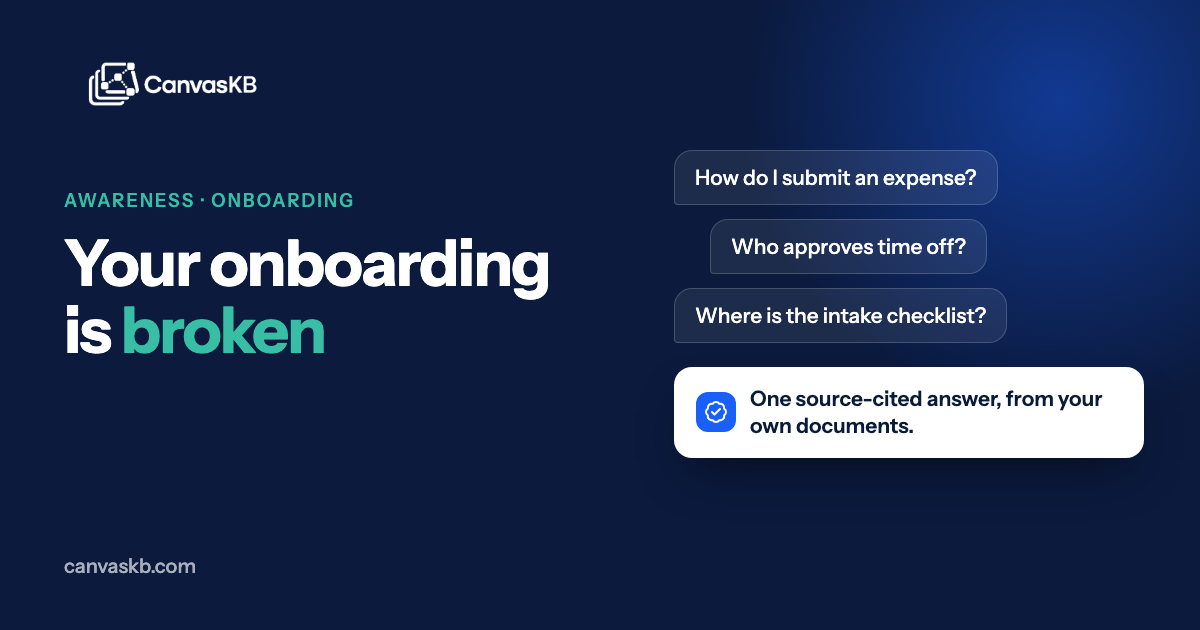
Every new hire's first month follows the same script, and it's rarely a good one. Day one is orientation and paperwork. Days two to five are reading the employee handbook, getting the lay of the business applications land, meeting people, making small talk and getting used to the “vibe of the place”. Week two is when the real onboarding starts, not in a training room, but in a string of small, half-answered questions, fumbling around to find the right documents for real questions. What's the actual process for submitting an expense? Who approves time off, and how far in advance? Where's the current version of the client intake checklist? It is somewhere, but who has the time to find it, read it and understand it? They just start asking, and keep asking, for weeks.
Why do new hire questions repeat every cycle?
Here's what I've noticed after watching this play out at company after company: the questions a new hire asks in their first month are almost never new questions. They are the same handful of questions every new hire before them has asked, going back years. What's different every time is who answers them, how long it takes, and whether the answer is even still accurate.
What does slow onboarding really cost?
That inconsistency is the real cost of slow onboarding, and it's bigger than most leadership teams realize. A new hire who gets a fast, correct answer for every question in week two starts contributing in week three. They also become champions of the company. A new hire who spends that same stretch guessing, waiting on a manager's calendar, or getting three different answers from three different colleagues, is still ramping in month two and becomes a frustrated employee. Multiply that gap across every hire in a year, and you're not looking at a minor friction point. You're looking at a meaningful drag on how fast new revenue-generating or operationally critical staff become productive, impacting your bottom line.
Why aren't checklists and onboarding buddies enough?
The instinct here is usually to fix this with more structure: a longer onboarding checklist, a better welcome packet, a dedicated onboarding buddy. Those things help at the margins, but they don't solve the underlying problem, which is that the answers a new hire needs, instantly and correctly, are buried in policies, SOPs, and handbooks that a first-week employee has no idea how to search. You can't expect someone who started four days ago to know that the travel policy lives in a folder called "Ops_Legacy_2019." So they don't look. They ask a person, usually someone busier than they realize.
There's also a quieter cost here that leadership teams rarely track: the manager time this consumes and the new employee experience it creates. A manager fielding the same onboarding questions from every new hire on their team, every quarter, is spending real hours re-answering things that were already written down once. That's time that should be going toward actually developing the new hire, not repeating the employee handbook out loud.
How can new hires get answers from day one?
This is exactly the gap we designed CanvasKB to close. From day one, a new hire has a single place to ask any question, in plain language, no training required, and get an instant answer sourced directly from your actual policies, with a citation showing exactly which document it came from. It doesn't matter if the manager is in a meeting or the founder is traveling. The answer is available the moment the question comes up, and it's the current, correct version every time, because it's pulled live from the documents you've approved, not from whatever a colleague half-remembers. Onboarding stops depending on who's around that day, and starts depending on documents that are always on. CanvasKB is live for all employees. All you do is “go to CanvasKB and ask away”.
Onboarding stops depending on who's around that day, and starts depending on documents that are always on.
Common questions
What questions do new hires ask in their first month?
Almost never new ones: the same handful every new hire has asked for years, such as how to submit an expense, who approves time off, and where the current version of a checklist is.
Why is slow onboarding expensive?
A new hire who gets fast, correct answers in week two starts contributing in week three; one who spends that stretch guessing or waiting is still ramping in month two. Managers also spend real hours re-answering questions that were already written down.
How does CanvasKB help new hires?
From day one a new hire has a single place to ask any question in plain language and get an answer sourced from your actual policies, with a citation showing which document it came from.
See how new hires get answers day one
Related reading: Why New Hires Stall on Day 12 · Measuring the ROI of Enterprise Knowledge AI