By Vijay Jog
In short: Companies are data-rich and information-poor: the documents exist, but employees can't find the answers and interrupt a colleague instead. That is a search problem, not a discipline problem. CanvasKB turns your documents into a company knowledge base people can ask in plain language, with every answer pointing back to its source.
When I was running our business intelligence (BI) practice since 1995 (I am dating myself) or doing executive seminars on the subject, I used to say that many companies were DRIPs, “Data Rich and Information Poor” and our BI practice was their salvation for any and all “structured data” residing in “transactional” systems. However, every company I have ever worked with was facing another challenge. How to store unstructured documents: policies, founders' vision documents, mission statements, checklists, SOPs. Well, we had an answer: let us use a DMS like SharePoint, and our SharePoint practice will ensure that we design and build the right metadata tags. But it actually did not solve the problem; we pretended it did. The knowledge base was there, but adoption was disappointing, to say the least.
Why can't employees find what the company already knows?
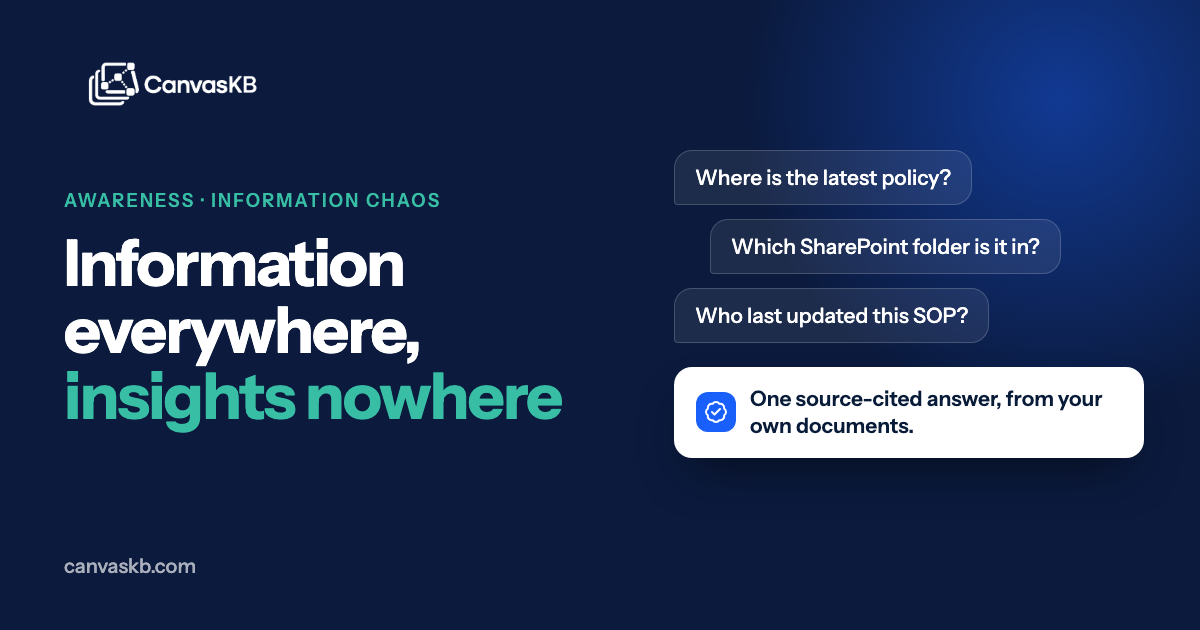
That's the line I now keep coming back to: information is everywhere, but insights are nowhere. They're hidden: buried in a drive nobody indexed properly, or worse, sitting only in the head of the one senior person who's been there fifteen years. So what do employees actually do? They click through SharePoint folders, hoping to guess the right metadata. Most give up before they find anything, and just ask around instead and interrupt a colleague or their manager, assuming that they know.
Is this a discipline problem or a search problem?
This isn't a discipline problem you can fix with a memo telling people to "use the shared drive and here is Enterprise SharePoint." It's a search problem. A folder structure is not a knowledge base, and a keyword search across a thousand documents is not an answer.
A folder structure is not a knowledge base, and a keyword search across a thousand documents is not an answer.
How does a company knowledge base like CanvasKB fix it?
We built CanvasKB to solve this challenge. CanvasKB turns all your documents, with no work for you, into something people can actually talk to. Connect SharePoint, OneDrive, or Google Drive, or just drag and drop into CanvasKB, and instantly your policies, SOPs, and playbooks become a knowledge base employees can ask questions of directly, in plain language, AND with every answer pointing back to the exact document it came from. You don't have to reorganize anything. You don't need a records-management project. You just need to know where your documents are: point and click, drag and drop and you are LIVE.
Sounds simple? Intrigued?
Common questions
What does "information everywhere, insights nowhere" mean?
It means a company holds plenty of documents, but the answers are buried in a drive nobody indexed properly, or sit only in the head of one senior person.
Why don't employees just search SharePoint?
They click through folders hoping to guess the right metadata, and most give up and ask a colleague instead. A folder structure is not a knowledge base, and a keyword search across a thousand documents is not an answer.
How does CanvasKB help?
CanvasKB turns policies, SOPs and playbooks into a knowledge base that employees can ask questions of in plain language, and every answer points back to the exact document it came from. You connect SharePoint, OneDrive or Google Drive, or drag and drop documents, without reorganizing anything.
Related reading: Your Company Already Has the Answers · From a 70-Page Playbook to an Answer Engine